
Translation (1937) of the dagger fighting techniques of the martial lineage of the Royal House of Miraj Senior

By: Sir Gangadharrao Ganesh Patvardhan, Raja of Miraj (Senior)
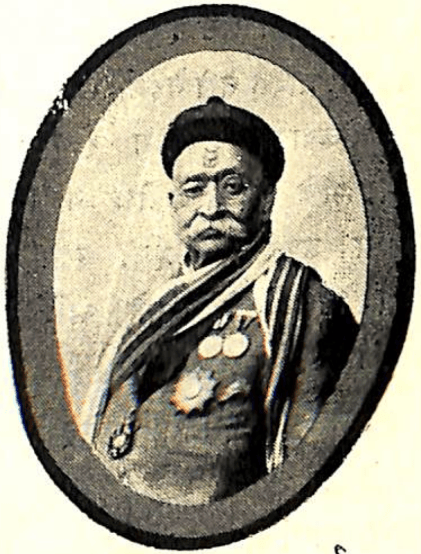
In old times when the discovery of gunpowder was not made, at that time hand-to-hand combat used to occur. At such times, use of sword, patta, jambiya, etc. weapons used to happen a lot and because of that, army people were taught to use these weapons in a good manner. In actual battle, to be able to defend oneself from the enemy and strike them, sciences of using these weapons had come into existence. Such sciences were taught even during times of peace to make army people experts. To ensure these weapons could be used in a proper and efficient manner, the tricks of using them were taught and along with that, to use weapons forcefully, with skill and agility, a specific type of training was given to hands, feet, and eyes to prepare those organs. To ensure the strikes of those specific types of weapons could be done correctly, the masters of those sciences used to establish certain types of movements to prepare those organs. There is a custom of calling them ‘Ghai’ (drills).
To prepare for sword and shield combat, the plan for Fari-Gadka was made, and to strike various types of blows correctly, certain ‘Ghai’ (drills) were established in that manly sport to prepare the eyes, hands, and feet. The same is the situation with Jambiya fighting.
About 40 years ago, an excellent master of Jambiya fighting came to me. Having seen his skill, I kept him with me for a few days and obtained information about this science. We have seen Jambiya fighting in many gymnasiums but its ‘Ghai’ had not come into our sight. To give a clear idea of where the blows of the jambiya can be struck on various vital spots of the body, a picture of a man is given and those places are shown on it. Later, after striking various ‘hands’ (moves), certain ‘Ghai’ are given to prepare the eyes and hands to ward them off. Even if practicing these drills feels tedious, if they are mastered well, they are very helpful for the subsequent game and in actual emergencies. These drills should be performed by two people standing up. Thereafter, counters (Todi) for various strikes, to be done sitting and standing, are shown and finally, a few samples of how chains (Sakhlya) are formed while doing various strikes and moves are given.
Map of Baank (curved dagger) Strikes:
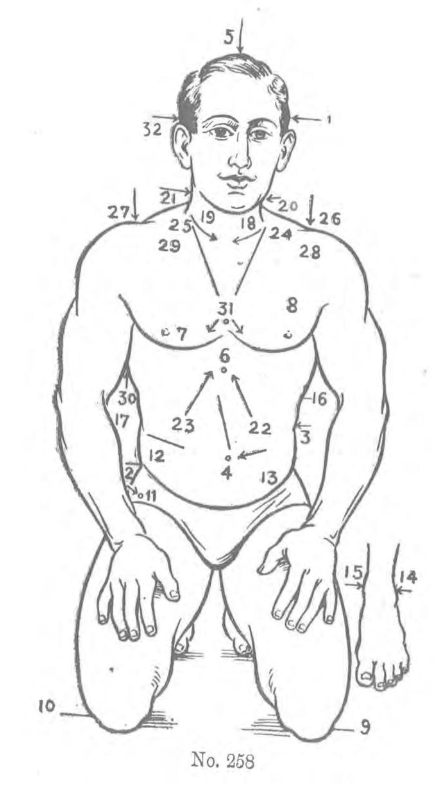
Map of Baank (curved dagger) Strikes: of strikes are given here:
- Tamacha (strike to the side of the head)
- Kamar (waist)
- Kotha (flank)
- Cheer (belly slicing strike)
- Sheer (crown of head)
- Hool (thrust/feint)
- Antara (inner strike)
- Palta (reverse/counter strike)
- Janu Sidha (straight knee strike)
- Janu Ulta (reverse knee strike)
- Ran (thigh strike)
- Bhandara Ulta (reverse ribs)
- Bhandara Sidha (straight ribs)
- Palat (ankle)
- Kadak (knee)
- Pahil Sidha (straight side)
- Pahil Ulta (reverse side)
- Halqum Sidha (straight throat)
- Halqum Ulta (reverse throat)
- Shah-rag Sidhi (straight carotid)
- Shah-rag Ulti (reverse carotid)
- Janwa Sidha (straight diagonal)
- Janwa Ulta (reverse diagonal)
- Hemayal Sidha (straight chest diagonal)
- Hemayal Ulta (reverse chest diagonal)
- Modha Sidha (straight shoulder)
- Modha Ulta (reverse shoulder)
- Hasali Sidhi (straight collarbone)
- Hasali Ulti (reverse collarbone)
- Bagal (armpit)
- Seena (chest)
- Bahera (outer strike).
How to Play:
Note: Read the following information assuming the boy in the striped vest in the pictures is the striker and the boy in the plain vest is the blocker (opponent).
1. Only one person striking various blows and the person in front simply blocking them. In Jambiya fighting, the main thing is catching the opponent’s hand before the strike lands. The striker must practice hitting various parts of the body, and it is very important for the opponent to practice catching the weapon hand in the blink of an eye before these various strikes land. Therefore, to develop such a habit, it is easier and more convenient at the start for one person to strike various blows and the other to practice blocking them; thus, some such drills are given first.
2. After blocking the striker’s blows, the person in front strikes back and the first striker blocks them. After practicing as mentioned above, the blocker should practice striking back, and the first person should practice blocking the opponent’s strikes. For this, some such drills are given. Both these types of drills should be done first sitting and then the same drills should be done standing, which develops the habit of striking and blocking while standing.
3. Todi (Counters)—Taking control of the striker’s weapon hand and striking them. After becoming accustomed to the drills while sitting and standing as above, the habit of taking the striker’s weapon hand into control and striking them should be practiced sitting and standing. For this, some such drills are given. Some of these drills are given to be done sitting and some standing. To understand at which places the various jambiya strikes are to be made, a picture was given first. Accordingly, the habit of striking all blows and blocking them should be practiced. A few drills of strikes are given in this book as samples.
4. Sakhlya (Chains—Jambiya wrestling moves). While doing Jambiya wrestling, both players block each other’s strikes and perform various wrestling moves, counters, etc., and finally, when one’s weapon is taken away or their weapon hand is tied, this wrestling ends. To give a proper idea of these moves, chains of a few moves are given. These chains can be infinite.
Salute (Salaami)
Like ordinary wrestling, in this wrestling too, to show sportsmanship and generosity, there is a custom of saluting each other at the beginning of the match. The way that salute should be performed has been determined. Two photos of the salute, standing and sitting, are given.
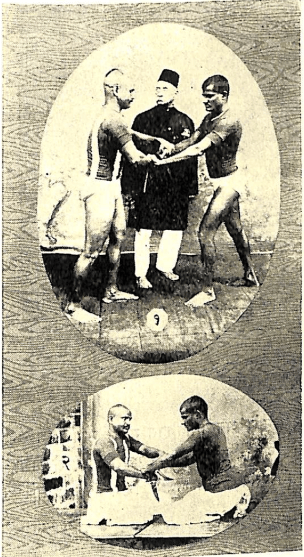
Standing Salute: Standing face-to-face as in image no. 1, each should hold the other’s right wrist with their left hand and perform the salute.
Sitting Salute: As in image no. 2, players should sit facing each other in the ‘khurmandi’ posture (bending the feet inward and sitting on them). Then you should hold the opponent’s right wrist with your left hand and the opponent should hold your right wrist with their left hand and perform the salute.